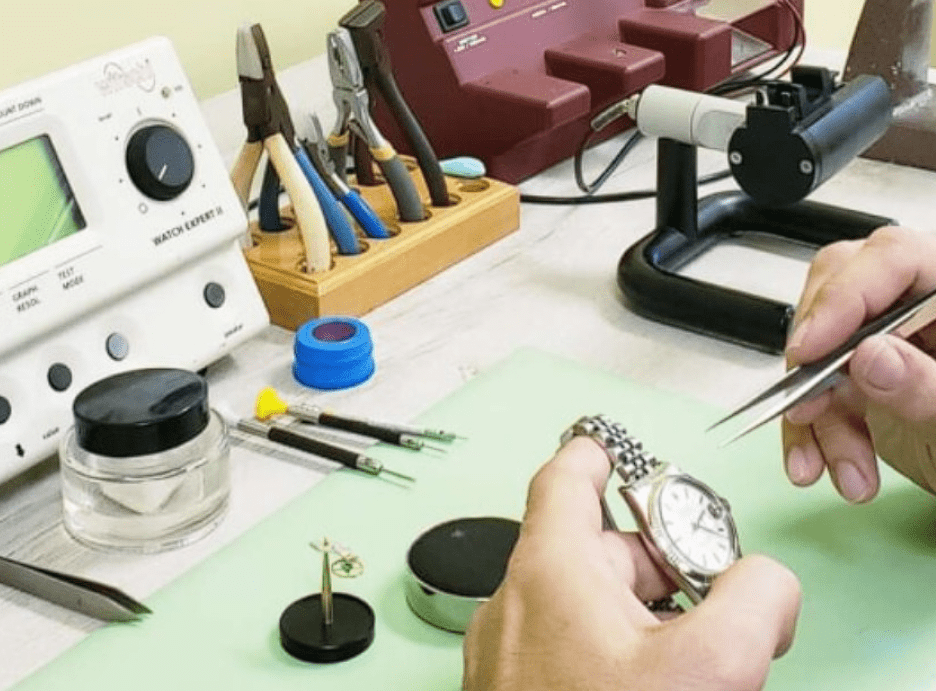
I was passionate about watch repair since I was a kid. My dad was a watchman, and I grew up around watches, tools, little screws, springs, gears, and all the strange little things that make a mechanical watch come alive. At some point I stopped just being the kid who was curious about watches and became a watch repairer myself, which, looking back, was probably inevitable.
Over the years, I have learned that repairing a Swiss watch is not just about knowing how to take a movement apart and put it back together, although that is certainly a big part of it. It is also about how you approach the work, because a watch movement does not care if you are having a bad day, if your phone is ringing every thirty seconds, or if you drank one coffee too many (or tea hehe).
The first thing I want when I sit down to work is quiet.
Not complete monastery-in-the-mountains silence, but enough peace that I can actually concentrate on what is in front of me. If I am working on a delicate movement and my phone keeps buzzing, I will sometimes just mute it and forget about it for a while. The world can survive without me answering a message for an hour.
Focus is a huge part of watch repair, especially when you are dealing with very small parts where one little mistake can turn a simple job into a much longer afternoon. And it doesn’t really matter whether I am working on an expensive Rolex repair or a more budget friendly watch, focus required is equivalent.
A Clear Space Means a Clear Head
I like to start with a clean and organized bench because when you are working with watch parts, a messy workspace becomes a treasure hunt very quickly.
You put down a tiny screw, look away for two seconds, and suddenly it has entered another dimension.
A clear workspace gives me room to work and, more importantly, it lets me know where everything is supposed to be. I want my tools within reach, my parts organized, the movement properly secured, and nothing unnecessary sitting around waiting to become part of the repair.
There is also something psychological about having a clean bench. When everything is organized, I feel more relaxed, and when I am relaxed, my hands are steadier and my decisions are better.
Your Hands Have to Be Calm
People sometimes ask me what the most important tool in watch repair is, and of course there are plenty of answers, but before you even get to the tools, you need control of your own hands.
Shaking hands are not your friend when you are trying to place a microscopic screw into the correct hole.
You need a steady hand, patience, and a certain calmness, because when you are working on a mechanical movement, even a very small movement of your hand can make a big difference. You are working with parts that are sometimes so small that you can barely see them properly without magnification, so there is really no room for rushing or forcing anything.
This is one of those things that is difficult to explain to someone who has never worked on a watch. You can know exactly what you want to do in your head, you can have the right screwdriver in your hand, and you can know exactly where the screw needs to go, but if your hand is tense or moving around too much, the watch is going to let you know about it pretty quickly.
I have learned that you have to get yourself into the right state of mind before you start. If I am distracted, tired, or thinking about ten other things, I know I am not going to do my best work. Sometimes that means putting the phone on silent, sometimes it means taking a few minutes before starting, and sometimes it simply means accepting that today is not the day to rush through a complicated repair.
Breathing and posture actually matter more than people might expect. When you are hunched over a movement for a long time and holding your shoulders tight, your hands eventually start to feel it. I try to stay relaxed and let the bench support my arms while keeping enough control that my movements are precise. It sounds simple, but after spending hours at the bench, you learn that comfort and concentration go together.
There is also a difference between having a steady hand and having a strong hand. In watchmaking, stronger is definitely not better. You are not trying to win an arm-wrestling competition with a Swiss movement. Most of the time, the lighter and more controlled your touch is, the better.
You learn to feel what the movement is telling you through the tools. A screw that is not turning properly, a component that does not want to move, or a part that feels slightly different from how it should can all be signs that you need to stop and look again rather than simply applying more pressure.
That is where experience starts to show. The longer you work on watches, the more you learn to recognize when something feels right and when something is telling you to slow down. Sometimes the best repair decision is not doing anything at all for a moment, but putting the tools down, looking again, and figuring out what the watch is actually asking you to do.
And yes, there are days when the hands are perfectly steady and everything goes exactly as planned, which is wonderful. Then there are other days when you somehow manage to drop the smallest screw in the entire workshop onto the floor, and suddenly you are on your hands and knees searching for something that appears to have developed a personal grudge against you.
That is watch repair too.